

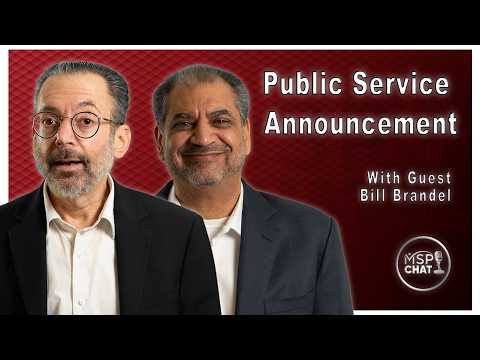
Listen to the podcast
Read Transcript
Transcript:
Rich: [00:00:00] Want to know what the smartest people in the SMB channel are reading? Check out Channelholic, the industry blog for me, veteran technology journalist and analyst Rich Freeman. Covering managed services, AI, cybersecurity, and M&A, Channelholic delivers sharp analysis and insider perspectives trusted by MSP executives, technology vendors, and IT investors alike.
If you want to understand where the channel’s headed next and why, check out Channelholic at www.channelholic.news.
And three, two, one. Bo Astoff, ladies and gentlemen, welcome to another episode of the MSP Chat Podcast, your weekly visit with two talking heads talking with you about the services, strategies, and success tips you need to make it [00:01:00] big in managed services. My name is Rick Freeman. I am chief analyst at Channel Master, the organization responsible for this show.
I’m joined physically side by side with your other co-host, our CEO and chief strategist at Channel Mastered. His name is Erick Simpson. And Erick, let’s answer the obvious question first. Where are we?
Erick: We’re in the east, in the northeast of the United States. More specifically, we are in Buffalo, New York at Ingram Micro’s Trust X Unplugged event.
Rich: So Trust X, for folks who don’t know, is Ingram Micro’s partner community. Trust X has existed as an organization under that name for a long time. There used to also be another community called SMB Alliance. They’ve combined those two together now into the Trust X Alliance. They are having their on- annual face-to-face meeting here today in Buffalo, New York.
And very quickly, Erick, before we start the show, I’m actually gonna take a few moments here to do a, a public service endorsement of Buffalo, New York. O- over [00:02:00] the weekend, I was talking with some friends, and a friend asked, “What… where are you off to next, Rich? You’re traveling all the time.”
And I said, “Buffalo.” And he was like sorry to hear that.” And I said, “No, you would like Buffalo.” The… Folks y- it’s a city that y- it might have a reputation in your mind. They were through some hard things before. But every time I come here, I’m reminded about what a great place Buffalo is.
They’ve got microbreweries all over the place, and restaurants, and great food. And we’re coming to you live from the Statler Hotel, which is where the event is taking place. This is a gorgeous 100-year-old building that’s still actually in the process of being renovated right now. They’re in the midst of a, a renaissance really here a- in Buffalo.
A piece of it is Ingram Micro has moved its entire Buffalo office to downtown Buffalo. They apparently have a, a beautiful building around the corner from where we’re sitting now. Don’t… If you get a chance to visit Buffalo, folks, I’m telling you, I think you’ll enjoy it.
Erick: Rich, I’ve been to Buffalo so many times bec- so because I’ve had clients here over the many years, [00:03:00] and I love Buffalo.
A- aside from the severe weather and, lake effect and all that, it is wonderful. The people are just so kind and welcoming. And yes, there’s all kinds of traditional Buffalo food that you would never know existed until you have a friend or colleague take you to a place and go, “Here’s where the birthplace of Buffalo wings was,” and, “Here’s what a chicken parm looks like in Buffalo.”
And it’s like nothing you could ever imagine. What’s under all that cheese? It’s But it’s a great place. I love it here.
Rich: I agree. I agree. So just keep that in mind. It’s a tip. Your first tip. Not even the tip of the week. Your first tip from Erick and Rich is-
Erick: And- …
Rich: Buffalo …
Erick: yeah, and drive right over and see the falls.
Niagara Falls is right here. So on the US side, and if you want, you can go on the Canadian side. So there’s that
Rich: All right. Let’s get to our story of the week, and obviously we’re coming to you from this Ingram event. So let’s talk to you a little bit about what I would call as the thoughts are getting organized in my [00:04:00] head for me to write an article about this in Channelholic, my blog a little bit it, and it was the very first thing that our interview guest, Bill Brandel of Ingram Micro, who’ll be joining us later on the show, the first thing he talked about when he came on stage right at the beginning of the day basically is that our industry right now is going through, obviously, an AI transition and transformation.
And it i- we live in an industry that is constantly in transition and transformation, but never really on the scale or at the pace of what we’re experiencing right now. It is an enormous change. It’s happening very quickly. It’s impossible for anybody to look even 12 months, 24 months down the road and really have a clear and accurate picture of what this industry’s gonna look like, what their business is gonna look like, what job roles are going to are going to look like, basically.
And everybody is going through this all at once. It- Ingram’s going through it. Its partners are going through it. End users that the partners serve are all [00:05:00] going through it simultaneously. So it’s a very exciting time in the industry, but also a little scary ’cause, change, when you’re rocketing towards it and you don’t know exactly where you’re headed, is inherently a little bit scary.
And just some of the particular kinds of examples that have come up of what partners are dealing with right now, Trust X members, and I have a hunch this will resonate for folks in the audience as well, right? We’re all familiar with what’s happening in the memory market right now, where the hyperscalers and the, the, the chip manufacturers are selling to the processor manufacturers, who are selling to the hyperscalers.
That AI business is dominating memory consumption, and so all of a sudden it’s very difficult for laptop makers or for you as a partner to get ahold of that. There are other hardware and infrastructure components that are in short supply right now, and partners are having to adapt around that issue.
There are price fluctuations going on. I was [00:06:00] speaking with a Trust X member today who was talking about how he sent a proposal out to a customer. Customer took a week to get back to him on that, and in that week, the price on a critical hardware component in this pr- proposal went up 40%.
Erick: Shut up.
Rich: And and so all of a sudden it was a very different conversation, and the partner made a very similar proposal to a different partner a few weeks later, and it was right back where it was before, the price on that component. So this kind of thing is going on. We’ve got people in response to those issues moving workloads into the cloud.
We’ve got other people Taking workloads out of the cloud and bringing them on-prem out of concerns about intellectual property leaking into LLM. Th- there’s a lot of change going on all at once. And it is apt, I think, for us to be discussing this right now at a community event because we talk regularly on this show about the the longstanding importance of community in [00:07:00] the IT world, and it was really a reminder for me today, it has been a reminder attending this event, that has never been truer than right now, where everybody is simultaneously trying to figure out a lot of things a lot of high-stakes issues all at once.
Doing it on your own has never been a worse idea. Having a community to turn to figure it out together has never been more useful and and more important. And so whether it’s Trust X or some other community, peer group, whatever it is that you have access to as a partner I, I would really just endorse the idea of finding other people to share experiences with and share best practices with and get through some of these transitions, these both exciting and scary transitions together.
Erick: Yeah, I agree, Rich. It’s, it’s one of the things that I love best about, the channel that we’re in, the MSP channel. It’s everybody, pitches in. [00:08:00] And if you need help there’s, communities like Trust X Alliance, there’s peer groups, there, there’s, influencers and experts.
The, the options are much, much greater than when I had my MSP, back in the day. And you know what? I think about that every time I say that. Man, I must sound like I came from the Stone Age. We had none of this stuff. We had to make the tools to make the tools, to do these things.
But, it’s the one thing I love best about it is having a network of folks that you can reach out to and get feedback. And, as Rich, MSPs don’t hold back. They will tell you exactly what they think and what they think you should be doing, and that’s the beauty of having a community like this and being in a channel that is so supportive compared to other industries and other verticals that we’re aware of.
Rich: Yeah. Hard to go it alone. Don’t go it alone. And and you and your community will get through it together. Now, speaking of ultimately exciting but at least temporarily [00:09:00] scary transitions, Erick, I think that is a good segue into your tip of the week because this is a scary transition for you.
Imagine what it looks like for your employees.
Erick: Yeah. Yeah. You’re right u- right on the money, Rich. I think, what we see and hear and read, online and in the news and the publications, the- there’s this one side that says, “My goodness, AI is gonna replace everybody, and it’s gonna be terrible.”
And then we see things from big companies that are, the layoffs because they’re replacing people with AI. That’s the very far side of what’s going on. I think, on the side that we are on more closely, it’s not that drastic of a switch. What we’re seeing is MSPs and their customers trying to figure out how to leverage AI to make them more efficient and productive.
Now, am I saying that, clients that [00:10:00] you work for may not, see an opportunity to reduce staff here or there? Not what I’m saying. But in general, there’s this idea that we as MSPs are more strategic with our clients- And we’ll walk, help them make, take advantage of AI in a very effective and positive manner to help them achieve their business vision and goals.
But let’s turn that mirror back on the MSP themselves and your staff. Do your staff wonder, listeners, if their jobs are at stake? What are you doing to empower them and give them that sense of confidence that we’re gonna leverage AI As customer zero first, right? We hear that a lot in the industry.
What’s customer zero mean, Rich? Customer zero means I’m going to adopt that thing internally and figure out all the bugaboos about it. Man, that’s a… I don’t know how that jumped into my [00:11:00] head. All the issues that might crop up, sand down the rough edges, and then deploy it to my clients. I think this is a perfect example of how to be a representative organization that says, “We’re gonna take AI into our organization.
We’re gonna leverage it for improvement. We’re gonna make our staff more efficient and productive. Now we are qualified now to bring that knowledge and expertise to you, clients.” And so one thing that I think is just a first simple step, Rich, would be to get the team together, and if you’re a larger MSP and have different business units, this– you may do this by business unit, but just in general, sit down with the team and say, “Hey, we’re gonna block out some time on, pick a day of the week and take a, a longer lunch. Bring in some pizza and sit down and say, “We’re gonna do a prompting workshop, okay? I want every one of you to come to this meeting with two [00:12:00] things that you think are the most time-consuming and noisy thing that you do, and we’re gonna see if we can’t write some prompts around it to help you execute that better.”
Let’s leverage AI this way. And you know what? Some may be winners right out of the gate. Some may be, eh, maybe that didn’t work out so well. But you’re gonna work on this, and I would suggest doing it a couple of times and perfecting this ability to write prompts for your team so that you can then take that and then l- lift it and present it to some of your clients because the sa- the challenges that your teammates have from sales, from service delivery, from support, from billing, from HR, from accounting, they have the same challenges that you have.
So this is a great way for you then to introduce an opportunity for your clients and say, “Hey, let’s do a little workshop. We’re gonna do a prompting workshop,” and introduce them. Get an assessment done of what they’re using and where the shadow AI is [00:13:00] and all that, and then deliver that same type of eye-opening experience so that you’re now leveraging AI for the benefit of your staff.
They feel more productive and accomplished. They’re working on the things they wanna work on, and the efficiencies and productivity that brings, and then you can introduce that to your clients, and then you can begin growing your AI strategy with your clients over time.
Rich: So I really that idea and I, I would say ideas like it, basically, where you come to your team with an AI-related skill, and you sit everybody down, and you work on it together.
And I like it for two reasons that have come up a- across the day here at this event. So first of all, the anxiety that your employees are experiencing right now is, “Am I gonna have a job in, in 12 months?” basically. And to the extent that you’re investing your time and going through these kinds of workshops with them, you’re basically telling them, “My goal here is not to get rid of you.
It’s to bring you [00:14:00] along with this company as it makes the transition into AI and I’m investing in that. We’re all learning this thing together.” And so that sends a very positive message to your employees. You’re not gonna be obsolete. You’re just going to be doing new and different and hopefully fun things.
The, the other thing is that e- every partner I’ve spoken with here said I’m not downsizing. I’m not looking to get rid of anybody.” But not everybody will still be around with the business going forward. You need people who are curious, who are willing to learn, who will go with the company on the journey to AI.
And these workshops are a way to figure out if there is somebody on your team- … who just really isn’t willing and able to embrace this particular change. And then you’ll find that out, too. So it’s a very practical thing to do in terms of skilling up the workforce. It sends a very positive message to them, and it also maybe exposes some some positive issues and less positive issues about who you have on the team.[00:15:00]
Erick: Absolutely, Rich, and I think it’s a You know it’s a way to bring the team together in a very different and unique way than they may be used to, right? Which is cool and fun. And, we’ve heard these kind of sessions called vibe- vibing workshops, things like that. You get the picture, right?
You’re gonna sit down with a team and start from prompting, and then over time you’ll say, “Okay, we’re gonna do the skilling workshop now. We’re gonna build a skill around kind of this motion that we’ve gotten behind.” And then maybe you can start creating agents or digital twins of the team. So you’re basically taking the internal team along that journey of AI maturity that then can translate into this is exactly how we’re going to work with every one of our clients moving forward, and add that strategic layer to the relationship.
Rich: Okay. That’s what we’re thinking here at the Trust X Alliance event. Let’s hear what Ingram Micro is thinking right [00:16:00] now. We’re gonna take a quick break here. When we come back on the other side I will be joined with Bill Brandel, he runs Ingram North America, and we will hear straight from one of the senior-most executives at the company about what he sees happening within the partner community in the AI transition for partners in general.
It’s all coming your way in a minute. Stick around. We’ll be right back.
Bill: And welcome back to part
Rich: two of this episode of the MSP Chat Podcast, coming to you very live from the Ingram Micro Trust X Alliance event in Buffalo, New York where I am very pleased and privileged to be joined by Bill Brandel. He’s the ex- executive vice president of Ingram North America.
This is probably your busiest day of the year?
Bill: Yeah, pretty much.
Rich: So we’re very grateful that you were able to take a little time out to join us on the show today. Absolutely. For folks in our audience who are unfamiliar with your [00:17:00] role, you and your role at Ingram, just give them a quick intro of who you are.
Bill: Sure. Yeah, no so it’s good to see you again, Rich. And I am the president of North America, which means I have responsibility for the US and Canadian businesses at Ingram Micro.
Rich: So you spoke on stage this morning about how the transition all of us are in right now is a very exciting one from a certain perspective, and a very frightening one from another.
Yeah.
Bill: Yeah.
Rich: Talk a little bit about what you are hearing from within the community a- about the, the anxiety maybe or the challenges of keeping up with a change this fast and this big.
Bill: Yeah. Rich, that- that’s a, a great question because at the end of the day, we’ve all gone through transformation in technology, right?
If you’ve been doing this for any length of time, there’s been change in technology. This is different because it’s the speed in which it’s moving, and I think, you get a lot of noise whenever there’s change. And whenever there’s fear, uncertainty, and [00:18:00] doubt, you get people that start to…
you get one group of people that kind of turtle, they clam up, and then you got another group that are gonna dive in and try to figure things out, right? The beauty of this community is no matter where you’re coming at it from, there’s going to be someone there that can relate and help you through your whatever in, insecurities or challenges that you might be facing.
So I think that’s the power of this community. And what I’m hearing a lot is just that how do we keep up with the rate of change? Because it’s moving at a speed that most companies haven’t been familiar with, and- and it’s really been a great exercise to get everyone together, hear their thoughts on how we keep pushing forward, and how do we learn from each other to move faster.
Rich: Above and beyond what you have long been doing within the community in terms of bringing partners together and so on, is there anything in particular you’re doing in Trust X or maybe just at Ingram specifically to help partners navigate that, that change better?
Bill: Yeah. So we have Enable [00:19:00] AI, which has truly been a, a thought-leading group of folks that a- are building a solution or a way to think about the solution, a way to assess where you are in your journey and look at where you want to go, and then provide you tools and a roadmap to get there.
So that’s something that we did early on. We’ve been perfecting that over time. Erick Gitter, who’s a gentleman who now reports in to my organization but still leads a global role is really responsible for helping to bring Enable AI to life. And what I’ve heard from partners that have taken the assessment is it’s a great way to gauge whether they’re in the early stages, if they’re in the medium stages, and then for those more advanced partners, it just validates where they are and if there are additional tips that they can pick up to plug into what they’re already doing.
And so that’s where we’re trying to stay ahead of things and keep all of that information real time and growing real time as we go. [00:20:00]
Rich: One of the things that came up on stage here this morning was just the challenges around navigating price changes and hardware shortages and so on. So what are you hearing from partners in terms of of how big a pressure that is for them?
And what are you doing to kinda help them pass that?
Bill: Yeah. Our role has always been key in that arena, right? Whenever there’s uncertainty in the industry, that’s kinda where I think we shine, right? When you take a look back at tariffs of 2025 and kinda how we helped partners navigate that, ’cause there was a lot of uncertainty then as well, right?
What was the pricing gonna look like? What were the tariffs gonna mean? And so really being able to make those strategic purchases of products to in- insulate partners from some of those fears is really our role, I believe. When I look at today’s market, it’s a little different because now you’re talking about a shortage of supply.
And really when you hear about from a lot of the OEMs, it’s about the timeframe in which they think this is gonna finally [00:21:00] kinda get to resolution, right? And so I think we’re in it for a little while, and so our job is to really help partners understand where they should be placing their bets, and help them navigate the uncertainty through giving them recommendations around the products that we know are available and kinda where we see the availability and the runway.
So a lot of time we spend helping our partners kinda navigate those uncertain times by just giving them visibility to where they could be placing bets, where they should be placing bets, and how we can help take some of the burden off by the way we operate as a company with taking a position with some, some of the inventory that we do in order to have it ready when they need it
Rich: Are you seeing either the the shortages and the, the price issues, or just AI b- because of the sorts of solutions partners are selling?
Are you seeing that change the kind of infrastructure that partners need and are purchasing? Or let’s keep it to hardware first, and then I wanna ask about the software and cloud side of that too. Sure. [00:22:00] But are you seeing different kinds of purchasing patterns, both from the end users and your partners?
Bill: I think the interesting thing, Rich, that I saw was there was a little bit of a pause on the refresh. When you look at the Win 11 refresh, there was a little bit of a pause depending on the t- partner type, right? Where you had enterprises that were moving full speed ahead, but I think you had a big segment of the industry from an end user perspective that was still kinda deciding, “Do I want an AI-enabled laptop, or am I good with just, getting a laptop that can…
I can refresh to Win 11 and it’ll handle today’s technology needs,” right? And so there was a little bit of that, and I think as companies sorted out what it meant to get an AI-enabled laptop versus not, I think that was where we saw a little bit of a pause. I think customers are a little more sophisticated now.
They know the direction they wanna go. So all I’m seeing now is really how companies are building, whether it’s AI in the data center, AI on the edge, where are they making that investment. I think you’re seeing a little bit of change [00:23:00] there. But it’s really as more and more partners are getting sophisticated at helping their customers understand their needs.
Where do they really need the power of AI? At the, at the edge where the data’s being driven, or can it be done in the data center where they can then do the compute and send it out? So it’s really just that piece of education that’s gotten better. So I just think now the buying’s becoming more purpose-driven.
Rich: I was talking to a Trust X member earlier today who was saying basically that some of the complexity and the challenges around hardware and infrastructure is actually accelerating migration to the cloud. I know you guys in the previous quarter reported something like 30% year-over-year cloud growth.
Are you seeing AI, whether because of the… it’s because of the hardware issue or just because of the nature of AI, are you seeing AI drive the cloud business at Ingram?
Bill: That is a very interesting conversation right now. You’ve got almost two sides of the coins here, right? Where the cloud can play a key role in [00:24:00] moving non…
what I’m seeing is partners are migrating workloads to the cloud where they know they can manage it correctly and manage it efficiently, and they’re looking at on-prem solutions for that data intense AI infrastructure, right? So what we’re seeing is a refresh of data centers enabling AI to…
more AI that’s really true to their IP driven on-prem, and then they’re moving other workloads to the cloud. I would say it’s been a pretty decent… The cloud growth I think is unique this year or last year. I believe that the… what we’re seeing in the cloud is more of companies getting sophisticated in how they’re building out their infrastructure, right?
Where are they placing their investments on-prem to build out a modern data center of the future that can handle the AI compute capacity, and they can control it, versus the cloud where they can move out and take some of that workload, move it out to the cloud, and manage it, have the cloud infrastructure manage it very securely, and they can, [00:25:00] actually communicate back and forth really well and take their data back and forth really well.
So I think what we’re seeing is just a, an evolution of what the data centers of the future are gonna look like, and I think it’s gonna be heavily focused on hybrid. There’s going to be a strong on-prem focus as well as a solid cloud strategy. ‘Cause it comes down to cost. Can I do AI cheaper in the cloud?
Is it gonna be cheaper for me to do it on-prem? Where… What AI am I gonna do where?
Rich: A- and this came up a little bit this morning as well. To what extent is AI driving that hybrid kind of architecture because people want to have the the IP, the intellectual property, on their own hardware?
Bill: Yeah. Yeah, I think, I think- Cloud providers have been very sophisticated in, as they build out their offerings and helping steer workloads into their environments, right? That makes sense. I think you’re right. I- In the early days of cloud, we saw a lot of people put everything out to the cloud, and then there was this re- [00:26:00] almost a reinvention or a we’re gonna re-architect kind of how we’re doing things because we do want our IP on-prem so that we can manage it effectively.
Especially with AI, we’re gonna get more benefit of what we’re doing locally here on our own infrastructure. So I think you’re just starting to see people truly understand where their data works best for their n- for their companies and for their business needs and for their business outcomes.
Rich: So one of the questions I showed up here at the event this morning thinking that I would ask you when it got time to speak was, ’cause you are paid to think strategically on behalf of Ingram Micro, what is the biggest strategic threat that you think about?
And as it happens, that’s exactly where you went. I didn’t even have to ask you. Yeah. The first thing- Yeah … you talked about on stage this morning. For folks in our audience who were not there what is that that big sort of hyperscale or related strategic threat that you folks faced and continue to face in some respect at Ingram, and what are you doing about [00:27:00] it?
Bill: Yeah. It was that’s a great point. And the reality is, and I’ve been doing this for a very long time, so I’ve watched this evolution happen. What was happening is AWS and Microsoft were trying to solve their business problem, right? They needed to get reach and scale, and so they were building marketplaces that truly could do a lot of similar things that we were doing at the time, right?
And I think in order to further their, where really what their objectives were and what they were trying to achieve it actually looked like it could’ve been a competitive threat. It was really a kind of approaching that area where it’s like, “Hey, this could kinda be a competitor we didn’t expect to see.”
Obviously, it wasn’t intentional, and I think when they saw us make a significant investment in platform and they saw that, “Hey, we can plug into Ingram the way we do with our traditional business,” I think this is a way for us to get scale just like they provide us in every other aspect of our businesses.
So what we saw is a way for them to engage with us differently and for us to engage with them differently, and really have our platforms cooperate versus compete, and I think that’s been a [00:28:00] far better scenario for both of us. Had we not jumped in and kinda taken that platform approach, I really wonder where we would be right now.
They still need to solve their problem of how do we get scale and how do we get to the masses. We are now providing them that through our platform and plugging into what they’re doing in order to go to market collectively, and I think we’re stronger when we’re together. We’ve always proven that out.
Knock on wood, still looks that way.
Rich: So you you acknowledged on stage this morning that disintermediation possibility- Oh, yeah … you at one point faced. Yeah. Theoretically the same thing is true for partners- … in terms of business going direct and so on. So for the partners in our audience right now you’ve just described what you guys did to eliminate s- the threat of disintermediation.
Yes.
Bill: For
Rich: partners who are concerned about that what should they be doing?
Bill: Yeah. I… Okay, so this is gonna sound like a selfish plug. Sorry about that, but it is the way I truly believe. I think, engaging with Ingram, partnering with Ingram, and making sure that [00:29:00] we’re helping them navigate the complexities of the hyperscale sit- opportunities I think is going to be a critical step.
Because at the end of the day, hyperscalers are gonna do what they need to do that’s good for their business, and we are gonna work together to support them, right? But when a deal does go direct through a hyperscaler, one of the things that the, the resellers have to think about is the vis- visibility to that deal down the road, right?
When you work with Ingram Micro and we help you with the partner of record conversation and drive that through to your end customer together, you’re always gonna have control and visibility of that solution through its entire life cycle. And so I think that’s one of the things I would tell partners.
This is where you’re gonna be able to partner with Ingram and play a, a role in helping you manage the overall relationship with your end customers w- throughout the life cycle of the solutions you’re selling.
Rich: This was something that you touched on this morning as well. I’ve spoken about it with some of the the members here today.
It’s one thing for a, a business owner or [00:30:00] manager to face the the challenges of the AI transition. They’re the d- decision maker ult- ultimately, but their employees are watching other people make decisions. They’re reading things that suggest maybe my job doesn’t exist-
Bill: Yeah …
Rich: and what t- to what extent are are Trust X members kinda dealing with that workforce transition, and what best practices are emerging in terms of how to deal with that?
Bill: That is an amazing question and a very timely question because I think we’re all facing that, right? I talked a little, you heard me talk a little bit about that. I think at the associate level it’s that fear of the unknown, and it, and I would say it goes like that in every transition we’ve had.
Heck, when we got the internet and we got email, it was like, “Oh, my goodness, what is this gonna mean to my business,” right? Then we went to cell phones and it, and the cloud, and what does the cloud mean? How are we gonna be doing business? I do software. And so I think, like anything else, it’s communication.
It’s making sure that you are communicating to your teams openly and transparently. [00:31:00] Look, AI is gonna create amazing things. It’s absolutely gonna change the way we do things. The things that we think are valuable today that we are doing as people will be automated, and it will be of little value for us to do anymore because there will be systems that can do it.
So now our job is to figure out, how do we evolve now? How do we take that next step in our roles? So as a salesperson, how do we come, how do I become more of a consultant? How do I help customers navigate the complexities of where they wanna take their businesses, how they wanna build their businesses, and what do they want that pro- that portfolio to look like and where are they gonna invest in technologies going forward, right?
So I think that’s really where the fear comes from when you don’t know. It’s that uncertainty, and the more you can communicate, and we talked a lot about it. I’ve been talking to partners all day about that. The more transparent you can be with the vision of where you wanna go and how you’re gonna leverage the technology to get there, [00:32:00] I think that solves a lot of the issues of people being afraid and and for you getting any resistance to the adoption
Rich: And it seems like part of what makes openness and honesty and transparency important right now, given the fact that things are changing very quickly and you can’t paint an accurate picture for people of what- this business is gonna look like in two years it, part of the payoff, and it, this for me as an attendee here, this is, this like puts a bow on the whole thing. I’m sitting here at a Trust X event. It’s got trust in the name of the organization. And it just feels like a moment in time in this industry when trust has never been more important, that you’re open and transparent and honest with your employees so that they trust what they’re hearing from
Bill: you.
Yes. Yes. So I will tell you, to your point, and I’ve, we’ve gone down this path before even in my organization, right? Where we put our best foot forward and say, “This is where we’re going,” only to find out [00:33:00] that, hey, you know what? Some of the assumptions we made, we’re tweaking them. The sooner you can get out with that message and say, “Hey, we thought this is where we were gonna end up.
We think we’re now gonna go over here,” the more you can do that right when you make the decision and be super transparent and open with people, what I am finding from our team is they’re far more likely to embrace the fact that we do have to make the change. They know we’re doing it for their best interests, and I think that’s all that matters for all of us, is to make sure our teams know when we do have to pivot and when we do have to make these changes, it’s really because we’ve learned something that we didn’t know because of just how fast the technology’s moving.
Rich: Bill like I said busiest day of the year for you. Probably one of the better days as well. It is.
Bill: I love it.
Rich: So we do appreciate you very much taking some time out to join us here. For folks in the audience who might like to follow up, learn more about you, get in touch, where should they go?
Bill: Sure. So you can call me direct- or email me directly at WW- Oh, WWW. I’m gonna say that again. [00:34:00] You can email me directly at [email protected]. Shoot me a note. I will be happy to answer any question I can, and believe me, if I can’t answer it, I probably got a whole group of people that can back me up, and I’ll make sure you get to the right place.
Rich: All right. Thank you very much to Bill Brandel. Folks, we’re gonna take a quick break here. When we come back on the other side, Erick will be joining us. We’ll share some final thoughts about the goings-on here at the Trust X Alliance event have a little fun, wrap up the show. Stick around.
We’re gonna be right back
And welcome back to part three of this episode of the MSP Chat Podcast. Thanks again to Bill Brandel for joining us for a bit here on the show. Very interesting conversation Erick. We were talking earlier in the show about how community has never been more important for partners or in the channel right now.
And where we … Where Bill and I kinda wrapped up is a [00:35:00] similar sort, thought. So we’re at an event being hosted by Trust X. Trust is in the title. Trust has never been more important in the channel than it is right now, precisely because as, as we were saying at the beginning of the show you’re not the only one who’s going through the AI transition right now.
Your customers are as well. They’re less tech savvy. It’s even more a fear and anxiety producing than it is for you. And they want help and they want answers, but they wanna get it from somebody that they can trust. And so there really has never been … and it’s interesting, as we’re talking about this, it occurs to me this is something that they hammered home hard at the Pax8 Beyond event that we attended a few weeks back as well that the advantage that you have competitively as an MSP right now as all this stuff is going on very quickly, is that trust that you’ve earned with your customers and the trust that that they place in you to help them through this.
So yeah, the, the, the whole concept of the trusted [00:36:00] advisor is as cliched as it gets in, in IT, but if you have earned that trusted advisor status with your customers, now is when it really pays off.
Erick: Yeah, no doubt. At the end of the day, clients are like we are as business owners.
They want to rely on trusted relationships to help them move forward. It’s as disruptive to one of your clients to have to go find another p- another provider for any of the services that, that they consume. Think if they have to go find another, legal relationship or another accounting practice.
Those are hard, difficult transitions, and none harder than replacing an IT provider. All right. Folks, that leaves us with time for just one last thing, and I believe I opened the show by making a sort of public service announcement with respect to Buffalo. I’ve got another public service announcement for you.
Rich: This is coming to us from the Ontario Provincial Police specifically their deta- detachment in Ottawa. And that announcement would be, [00:37:00] folks, don’t bring hand grenades to the police You wouldn’t think that’s a public service announcement that I need to make, but apparently the, the Ontario Provincial Police thought it was, because people show up now and again with hand grenades.
And you can imagine how this happens, right? Grandpa brought one home from- The war … yeah, exactly. And who better to deal with the issue than the police? I’ll just take it on down to the police station. Oh, my goodness. The police would like you to know, certainly in Ontario, probably anywhere, don’t bring us the grenade.
If you’re concerned about it, you can call us, and we’ll figure out a way to safely dispose of that for you, but we will thank you not to walk through the front door of the police station with a hand grenade. My goodness. I, yeah, no words for that one, really, Rich. Who are these people that are, like, just older folks that, they’ll, not thinking.
Erick: Haven’t they seen any of the news or TV shows or movies where you get the robot out, [00:38:00] and everybody’s wearing 14 layers of protective gear and, Wow, that’s… Yeah, I wonder how often that happens. And is it only relate- is it only affecting Canada? Good question.
Rich: We’ve just created a new mystery.
Do they have more grenades in Canada than here in the United States? Yeah. We’ll have to look into
Erick: this. Who’s stockpiling all these grenades in Canada?
Rich: That’s a question for another episode, though, folks, because that is all the time we’ve got for you on this episode of MSP Chat. Erick and I will be back with you for another episode in a week’s time.
Until then, I will remind you as I always do, this is both a video and an audio podcast, which means that if you are listening to us right now, but you’d like to check us out on video, go to YouTube, look up MSP Chat. If you’re watching us on YouTube, but you’re into audio podcasts, go to Apple, Spotify, Google, wherever you get your audio podcasts.
You’re gonna find us there, too, and wherever it is you find us, please subscribe, rate, review. It’s gonna help other people find and enjoy the show just like you do. This [00:39:00] show is produced by the great Riley Simpson, part of the team with us here at Channel Mastered, where we work closely with vendors to help them build, grow, and optimize thriving MSP channels.
You can learn about all the many ways we do that at our website, which is located at www.channelmastered.com. Channel Mastered has a sister organization called MSP Mastered. That’s Erick and his team working one-on-one with MSPs to help them grow and optimize their business. You can learn more about that at www.mspmastered.com.
So once again, we thank you for joining us. We’ll see you in a week. Until then, folks, please always remember, as we always ask you to, you can’t spell channel without [00:40:00] M-S-P.


No products in the cart.
Subscribe and listen to future MSP Chat episodes with your favorite podcatcher


You’ll see live:
october 22, 2026 @ 10am PT